Adaptation as relationship
Textbooks often present adaptations as features: thick leaves, deep roots, sticky traps. In the field, they look more like negotiations. A plant in nutrient-poor soil may trade with fungi or animals for nitrogen. A plant in a fire-prone landscape may only release seeds after flames pass. Understanding the partner or the event tells you far more about a habitat than the feature alone.
Pitcher plants that changed the deal
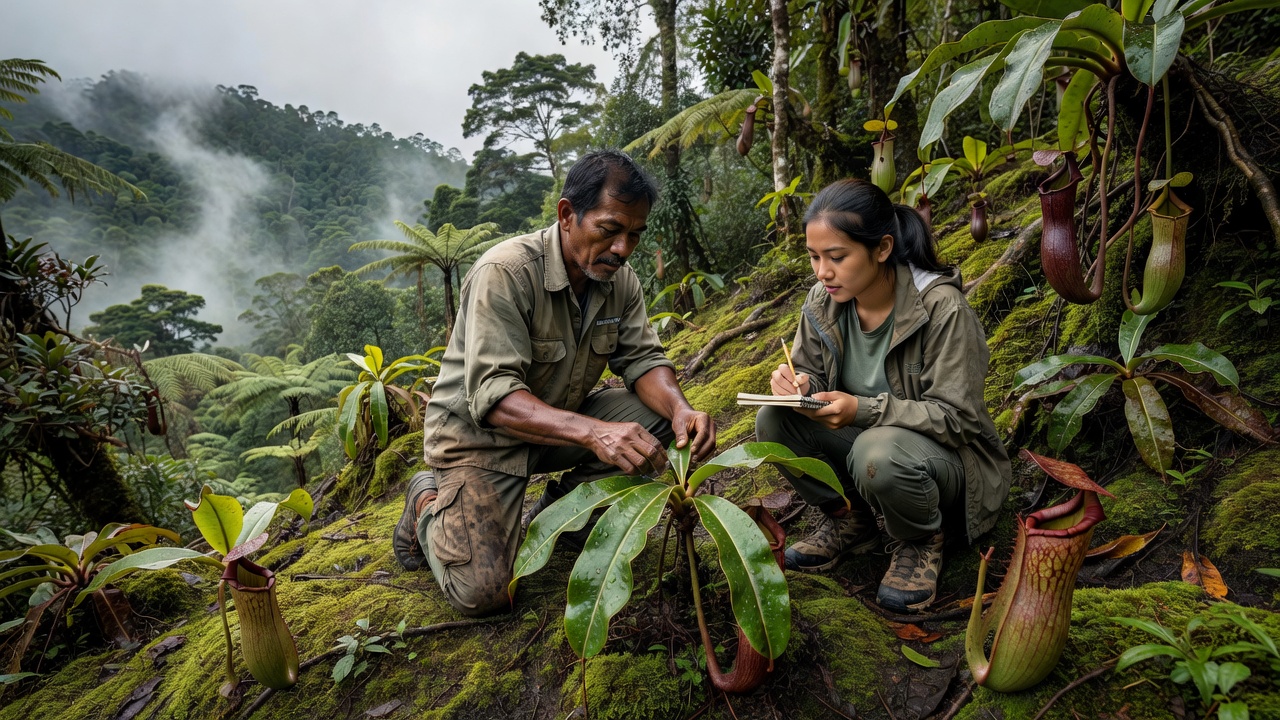
Nepenthes pitcher plants of Southeast Asia grow in poor soils and supplement their nutrition by trapping insects in fluid-filled leaves. On Mount Kinabalu in Borneo, some species have shifted strategy. Nepenthes lowii and its relatives produce nectar on the pitcher lid; mountain treeshrews visit to feed and leave droppings in the pitcher, supplying nitrogen. Another Bornean species, N. hemsleyana, shelters a small woolly bat whose droppings feed the plant. These partnerships were documented by researchers working with local guides who knew where to find the animals.
- Nutrient-poor soil
- Pitcher with nectar lid
- Mountain treeshrew
- Droppings in pitcher
- Nitrogen for the plant
Rafflesia: a flower without leaves
Rafflesia arnoldii produces the largest single flower known, sometimes close to a metre across. It has no leaves, stems or roots of its own. It lives as a parasite inside Tetrastigma vines, emerging only to flower. The bloom smells of rotting meat to attract carrion flies, which act as pollinators. Because Rafflesia depends entirely on its host vine and on intact forest, it cannot be protected in isolation. In Sumatra and Borneo, local villagers who guard flowering sites and guide visitors have become important to its survival.
Fire as a signal: the Cape fynbos
The Cape Floristic Region of South Africa is the smallest of the world's floral kingdoms and among the richest, with roughly 9,000 plant species, most of them endemic. Many proteas hold seeds in closed cones for years and release them after fire, a strategy called serotiny. Some fynbos seeds germinate in response to chemicals in smoke. Ants carry other seeds underground, protecting them from fire and predators. Too-frequent or too-rare fires can both disrupt this system, so fire management is a central conservation task.
Water specialists
CAM photosynthesis in succulents
Mangrove roots and salt
Living stones (Lithops)
Dragon's blood tree, Socotra
Why hotspots concentrate these stories
Biodiversity hotspots, as defined by Conservation International, are regions with at least 1,500 endemic vascular plants that have lost at least 70% of their original vegetation. Isolation, varied terrain and stable long-term climates encourage specialisation, and specialists are exactly the species most exposed when one partner disappears. The IUCN Red List tracks extinction risk and is the best single reference for checking a species' status.
Observation panel: watching adaptations safely
- Observe pollinator visits from a distance; flowers are often open for only hours.
- Never pour out pitcher fluid or touch Rafflesia buds.
- Use a hand lens rather than collecting specimens.
- Record what visits a plant, not just the plant itself.