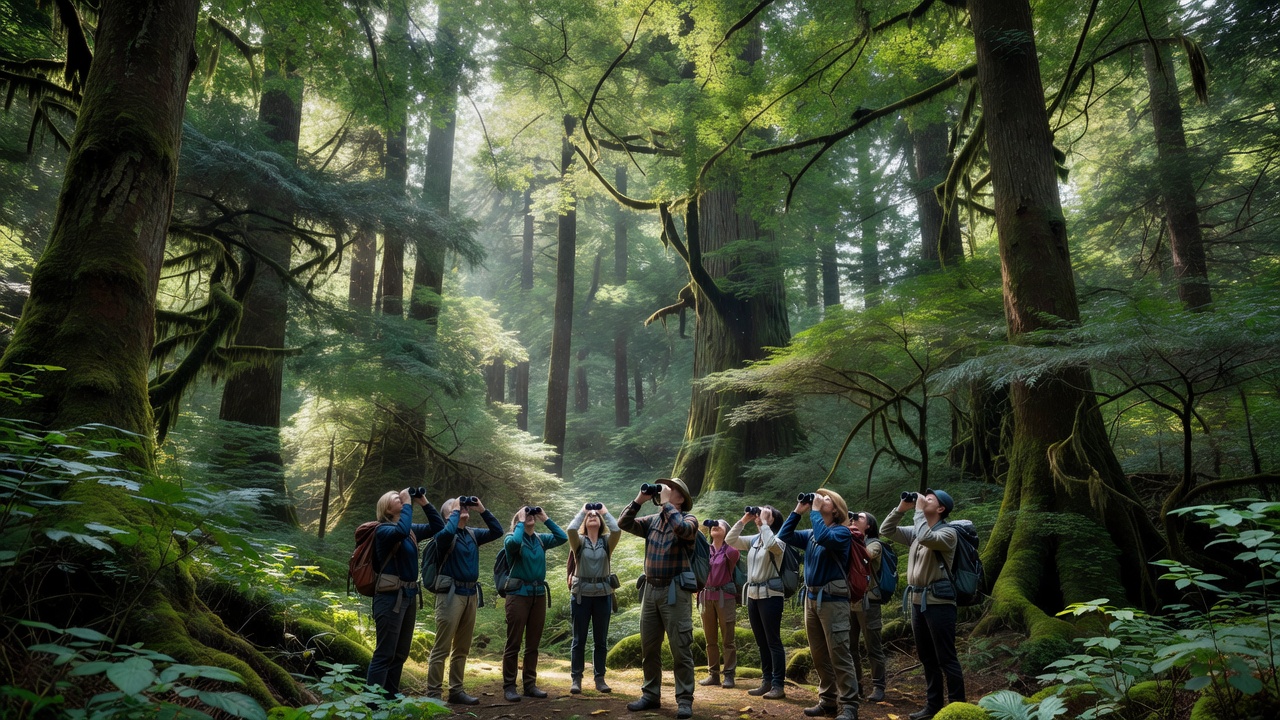
Start with the vertical story
Stand in any mature forest and look up, then down. The canopy captures most of the sunlight and much of the rain. Below it, shade-tolerant shrubs and saplings wait for a gap. Lower still, mosses, ferns and seedlings work in dim, humid air. Under the leaf litter, an enormous population of fungi, bacteria and invertebrates recycles everything that falls. Each layer creates conditions the next layer depends on: shade keeps soil moist, litter feeds decomposers, decomposers release nutrients back to roots.
Most trees also live in partnership with mycorrhizal fungi. The fungi extend far beyond the roots, gathering phosphorus and water in exchange for sugars. How much these networks move resources between trees is still debated among researchers, so we treat dramatic claims carefully. What is well established is that a healthy fungal community underpins tree growth, and that disturbing soil can break it.
Tongass: a forest fed by the sea
The Tongass National Forest in southeast Alaska is the largest national forest in the United States and one of the most extensive temperate rainforests on Earth. Its most famous relationship runs uphill from the ocean. Pacific salmon return to spawn and die in forest streams. Bears carry carcasses into the trees, eagles and gulls scatter the remains, and decomposing fish release marine-derived nitrogen. Studies using nitrogen isotopes have traced that ocean nitrogen into streamside vegetation, including Sitka spruce.
- Ocean nutrients
- Spawning salmon
- Bears & eagles
- Riverside soil
- Spruce growth
- Shaded, cool streams
- Salmon nurseries
The loop closes because trees shade the streams, keeping water cool enough for young salmon, and fallen logs create pools where fry shelter. Tlingit and Haida communities have long understood these connections; their fishing practices and place names record them.
The Valdivian temperate rainforest
On the southern Chilean and Argentine coast, the Valdivian forest is an ecological island, cut off by the Pacific, the Andes and the Atacama Desert to the north. Long isolation produced high endemism: the monkey puzzle tree (Araucaria araucana), the slow-growing alerce (Fitzroya cupressoides), which can live for thousands of years, and the tiny monito del monte, a marsupial that helps disperse the seeds of a mistletoe. That mistletoe depends almost entirely on this one animal, a reminder that a forest's distinctiveness often rests on a single pairing.
Białowieża: deadwood as habitat
Straddling Poland and Belarus, Białowieża Forest is a UNESCO World Heritage Site and one of the last large fragments of the lowland forest that once covered much of Europe. Here, fallen and standing dead trees are left in many protected areas. That deadwood supports specialist beetles, fungi and woodpeckers, including the white-backed woodpecker. European bison, reintroduced after extinction in the wild, graze clearings and help maintain open patches. Debates over salvage logging after bark beetle outbreaks show how hard it is to value decay as part of a healthy system.
Cloud forests: Monteverde, Costa Rica
Daintree, Australia
Boreal peat forests
Observation panel: on a guided forest walk
- Look up, then down: note which layer you hear birds in.
- Ask your guide which trees are culturally significant and why.
- Don't overturn logs; they shelter amphibians and fungi.
- Photograph fungi in place rather than picking them for identification.
When you next walk through a forest, try tracing one relationship from top to bottom. It might begin with a leaf and end in the sea.